
The traditional recipe tells you how to cook a dish. It has never told you what to do with what’s left over.
Working at El Celler de Can Roca has been the highlight of my culinary path. The intensity of daily service, the discipline of hard work, and the shared commitment of people from all around the world, each focused on the same goal, was almost impossible to put into words. There was a sense of collective purpose and excellence that felt close to perfect.
As with everything in my life that has felt close to perfect, I eventually noticed a quiet contradiction. Within this environment, built on deep respect for ingredients and craft, much of the food being discarded was not the result of neglect or poor quality, but of routine. Perfectly usable ingredients simply had no defined place once the recipe was complete.
As I looked more closely, I realised that the problem was not a lack of care, but a lack of instruction. Recipes, the very tools we rely on as cooks, tell us what to prepare and how to execute a dish, yet remain silent about what happens to trimmings, surplus preparations, and leftovers generated along the way. We work with precision and intention, yet what falls outside the recipe falls outside responsibility.
And yet the fix, when I saw it, was surprisingly simple. The traditional recipe format— title, ingredient list, and procedure—no longer reflects the sustainability values that many chefs strive for today. If recipes shape how we cook, then their structure needs to change. I began to imagine an addition to every recipe: a clear annex specifying exactly how the leftovers produced by that dish could be reused, transformed, or preserved, turning waste prevention into part of the recipe itself.

Elaborations require both energy and action, and the final products occupy valuable space in fridges and freezers, so the annex focuses on preservation techniques such as fermentation that extend shelf life, as well as methods that reduce volume, like dehydration and reduction.
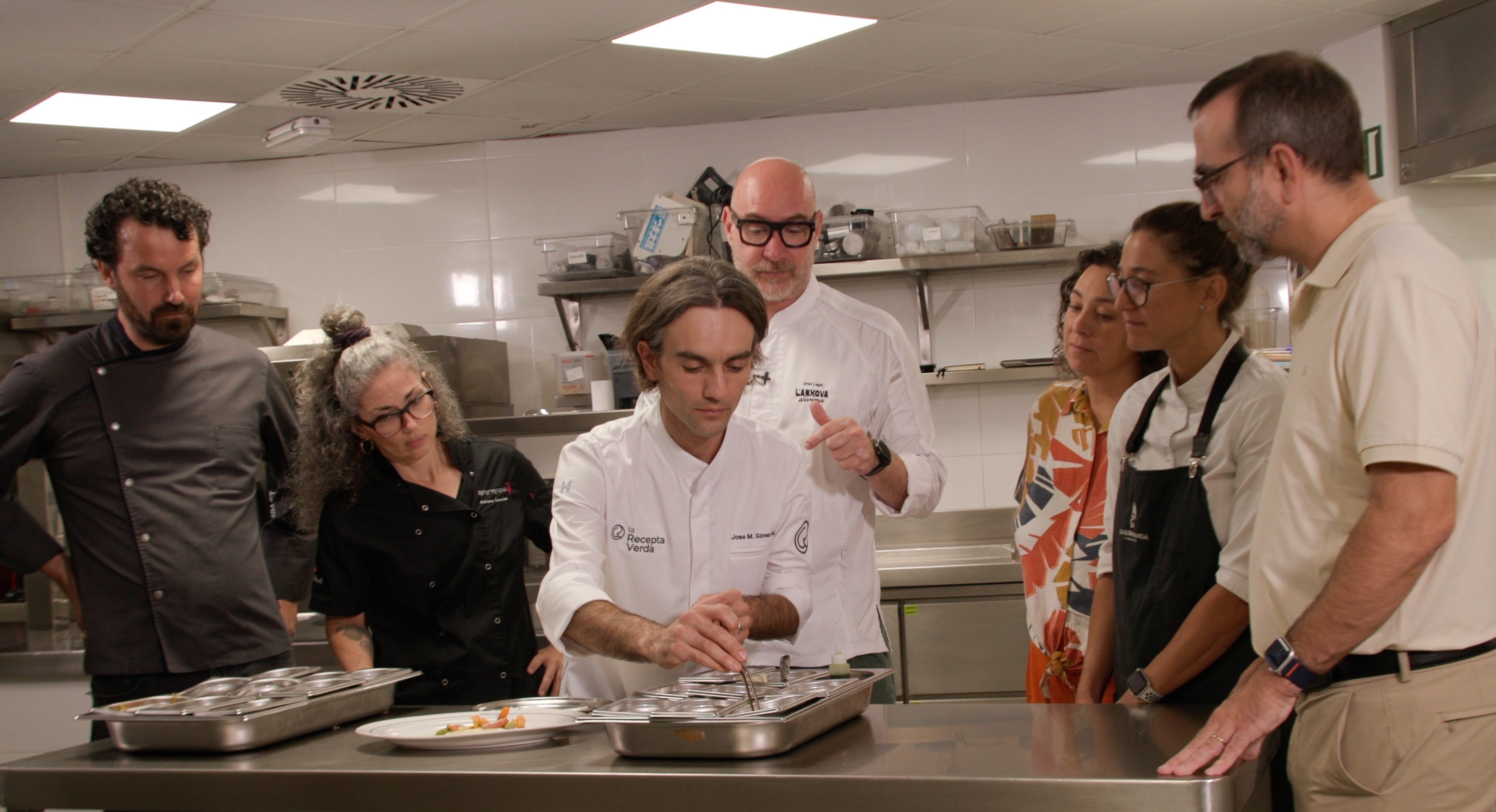
This is when La Recepta Verda (Rethinking Origin) was born. Rather than treating waste management as a corrective measure, La Recepta Verda focuses on avoidance, tackling the problem before it begins.
Today, with the support of the Generalitat de Catalunya and in partnership with the Coma de Meia Foundation, the methodology has been tested across a wide range of contexts: from the haute cuisine of El Celler de Can Roca to the social and inclusive environment of Ilersis Foundation; from the Pyrenean cuisine of Cafè Pessets to the agroecological space of Can Moragues, each experience has demonstrated the feasibility and adaptability of La Recepta Verda. The project has become a reality thanks to the collaboration of chef Sergi de Meià, with whom we have co-founded the methodology that is now actively in practice.

By reimagining recipes from their origin, chefs can find new uses for ingredients, train their teams to manage resources, and monitor waste systematically. Leftovers can enrich existing recipes, inspire new menu items, or be transformed into products for sale. And restaurants become spaces of education and cultural change.
This transformation must reach younger generations. For the past two years, I have taught a master’s-level course on Sustainability and Circular Economy at EUHT Sant Pol de Mar, sharing with international students the practical tools and philosophy behind our approach. By explaining the methodology step by step—how to observe, plan, preserve, and creatively repurpose ingredients—students learn not only the technical skills but also the mindset needed to integrate sustainability into their future kitchens.
Ultimately, La Recepta Verda is more than a way to reduce waste. It reconnects kitchen, producer, and territory, and turns what was discarded into something worth keeping. The recipe was always the most powerful tool in the kitchen. We just never asked it to do enough.
Here are two examples of La Recepta Verda in practice:

Mesclun Fritters and Romesco
During the implementation of the methodology at Can Moragues, a rural eco-restaurant in the province of Girona, we identified a significant surplus of mesclun. Due to its delicate nature and short shelf life, we proposed adding an RV (Recepta Verda) note to recipes containing this ingredient, directing the cook to prepare fritters as an appetizer, using the leftover salad greens.

Ensalada Tíbia
A changing salad that evolves throughout the year, giving a second life to vegetables at the edge of their cycle through different preservation techniques, set over a silky parsnip cream and finished with leek-green oil.
The dish was developed at L’Anxova Divina, by the team leads, and I am particularly fond of it as it allowed me to share and transmit knowledge of preservation techniques with the rest of the team throughout the year.
Personal Bio:
Jose Miguel Gómez Morales is a Colombian chef with over 15 years of experience. In 2016, he moved to Catalonia to pursue a Master’s in Culinary Arts at EUHT Sant Pol de Mar, where he also worked at the restaurant Sergi de Meià.
After graduating, he became chef de partie at Sant Pau under Carme Ruscalleda before joining El Celler de Can Roca, where he worked for six years.
Since 2024, he has combined his role as sous-chef at Hotel SLS Barcelona with teaching sustainability and gastronomy in the Master’s program at EUHT Sant Pol de Mar.
He is the co-creator of La Recepta Verda, a methodology that brings together sustainability, creativity, and circular thinking in contemporary gastronomy. In 2025, he became a MAD Academy alumnus and was recently named among Colombia’s “40 Under 40” by leading media outlets RCN and El Tiempo.